Last Updated on June 5, 2026 by David
Slate flooring can present various challenges such as fading, flaking, dull patches, white deposits, dark grout, edge build-up, and inconsistent colouration. These issues often stem from the stone’s layered structure, surface texture, moisture dynamics, and prior treatments, complicating regular maintenance. A thorough professional evaluation can help distinguish between wear from foot traffic, cleavage separation, trapped moisture, coating build-up, and the natural variability of the stone. Understanding these factors allows for tailored cleaning, sealing, repair, or restoration strategies.
Use the following links to diagnose your floor’s symptoms and access relevant sections for customised advice.
- Identify issues related to fading, flaking, dullness, and dark grout
- Learn how the origin of slate influences floor behaviour
- Discover reasons for persistent marks and moisture beneath the surface
- Understand the differences between smooth, rough, and heavily textured slate
- Examine dirt accumulation, traffic lanes, and persistent surface marks
- Find out why regular cleaning may not enhance the floor’s appearance
- Identify old coatings and uneven sealer build-up
- Distinguish between flaking, fading, and white deposits
- Set realistic care expectations for older treated slate floors
- Determine when slate issues require professional evaluation
- Select the right guidance for slate care
Key Factors in Cleaning, Sealing, and Restoring Slate Floors
Visible indications of fading, dull patches, dark grout, white deposits, flaking edges, or uneven coloration on your slate flooring may signify problems that extend beyond mere dirt. Elements such as foot traffic, outdated coatings, trapped moisture, and the stone’s layered structure can significantly affect the floor’s integrity. This complexity often complicates the evaluation of slate solely based on appearance, especially in UK kitchens, hallways, boot rooms, and historical cottages, where wear and moisture frequently converge.
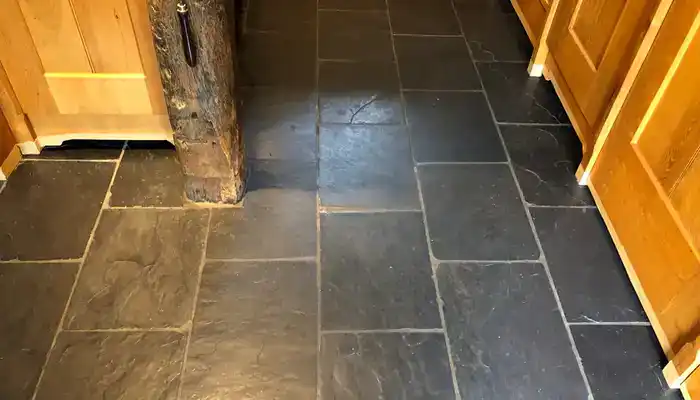
Slate issues often manifest as patterns rather than isolated events. Lighter patches may form in high-traffic areas, while darker edges can develop near tile borders. Low points in the texture may remain grey even after cleaning. In my experience, these signs generally indicate a combination of traffic abrasion, coating accumulation, edge build-up, recessed areas, and surface dulling rather than simply inadequate cleaning practices.
Loss of colour suggests that the surface has been worn down due to foot traffic, diminishing the visibility of the stone’s pigment. Homeowners may observe fading hues, light pathways, a chalky appearance, and overall visual degradation caused by tiny grit particles leading to microscopic damage in high-traffic zones. A standard professional assessment can determine whether the remaining mineral pigment can be revitalised or if extensive restoration is necessary.
The riven texture of the surface results from the mechanical splitting of the slate along its natural cleavage during production. Homeowners may notice ridges, troughs, and rough areas that trap dirt beyond the reach of typical cleaning methods. This texture not only complicates cleaning but also impacts sealing considerations, as protective treatments must enhance rather than obscure the surface’s character.
Sealer build-up indicates that older protective materials have formed layers rather than worn away evenly. Homeowners may see residue accumulation, excessive topical layers, application remnants, inconsistent finishes, and darker edges, especially in recessed areas. A professional evaluation can identify whether the floor has old acrylic coatings, wax residues, degraded topical protection, or a compromised internal barrier before applying new treatments.
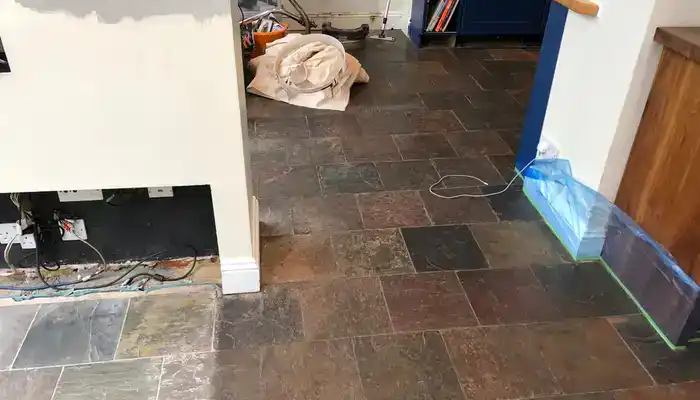
Delamination occurs when layers of slate begin to separate along vulnerable mineral planes. Homeowners may see flaking, loss of lamination, lifting edges, or small pieces shedding from the surface. The corrective measures focus on local stabilisation, repair, or replacement in areas where layer separation, foliation failure, and structural breakdown exceed basic maintenance solutions.
The behaviour of moisture plays a crucial role in the manifestation of other slate problems. High moisture levels, trapped water, vapour movement, and substrate moisture can lead to chalky residues, trigger efflorescence, and cause sealer failure if sealing is attempted prematurely. A drying period or additional assistance may be necessary before a reliable evaluation of the floor’s condition can be made, as damp slate can amplify the visibility of coatings, colours, and surface deposits.
White deposits should be distinguished from grey wear or dark stains. Efflorescence refers to the white, chalky substance that surfaces when mineral salts migrate with moisture and form deposits during evaporation. Homeowners might notice a haze around grout, in wet areas, or near damp edges after rinsing. Professional correction focuses on diagnosing moisture issues, managing drying, and applying breathable protection rather than trapping salts beneath another layer.
The geographical origin of the slate significantly influences how a floor can be evaluated. Welsh slate typically features high density, low porosity, and a robust surface considered a standard in the UK, while Indian and Chinese slates may be softer, more porous, and less uniform. Understanding the provenance of heritage slate is vital, as traditional slates, locally sourced materials, and varying batches do not absorb, wear, or respond to sealers uniformly.
Misguided assumptions can lead to unintended damage to a slate floor. Harsh acidic products, aggressive chemicals, bleach, steam cleaning, and abrasive pads can inflict surface damage, break down sealers, cause peeling, allow moisture penetration, flaking, or lead to irreversible colour changes. Slate is a fine-grained metamorphic rock that cleaves along its natural planes; its layered structure limits mechanical polishing and confines restoration to cleaning and sealing, making it sensitive to harsh cleaning agents.
Recognising these issues is essential for the slate care hub. This page does not provide a treatment sequence; rather, it clarifies material behaviour from cleaning issues, sealing failures, moisture movement, colour fading, and structural characteristics. The path to effective solutions becomes clearer when the visible symptoms of the floor are linked to the underlying physical causes instead of being dismissed as mere surface dirt.
How Does Geographic Origin Influence the Behaviour of Slate Flooring?
Slate that appears similar may exhibit different behaviours due to variations in quarry origin, which affect hardness, porosity, and colour response. Welsh slate is generally denser and less absorbent, while Indian and Chinese slates often show higher porosity, softer materials, and varying quality. These distinctions influence drying, sealing responses, surface wear, and the floor’s longevity under typical use.
The geological formation creates the layered structure that gives slate its unique character. Mineral planes allow the stone to split into sheets, but this same trait also introduces a risk of delamination at weak boundaries. Understanding the provenance of heritage slate is essential, as traditional slate with a hard, low-porosity surface behaves differently from softer domestic imported materials that have greater absorption risks.
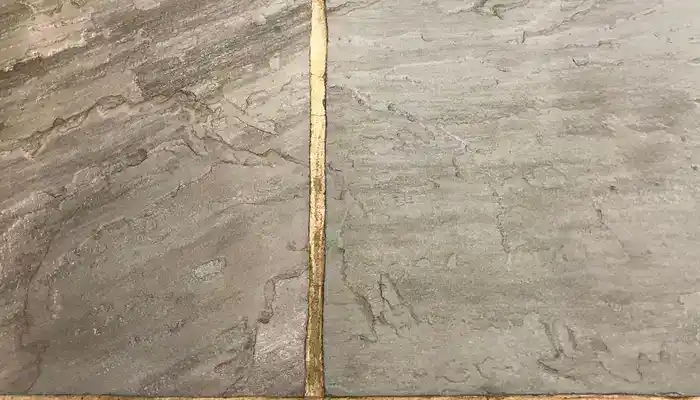
Conducting an assessment that considers the slate’s origin prevents a one-size-fits-all approach to care. A dense Welsh slate floor may require a different sealing strategy compared to Indian-origin materials with higher porosity or Chinese-origin tiles exhibiting variable quality. More information about the diagnostic process can be explored in Problems With Slate Floors Start Inside The Stone, where quarry behaviour and visible changes are central to the topic.
What Factors Cause Some Slate Floors to Retain Marks, Moisture, and Dull Patches Below the Surface?
Repeated scrubbing of a dull patch on slate can complicate diagnosis, as the mark may be embedded in the texture, coating residue, or moisture rather than just surface dirt. Low points, grout lines, and older floor constructions can trap water, soil, and dissolved contaminants beneath the reach of standard mopping, leading to patches that darken or reappear even after the surface appears clean.
Moisture entrapment refers to trapped water, high moisture levels, and vapour movement within or beneath the flooring system. Homeowners often notice chalky residues, slow-drying dark areas, hazy grout lines, or cloudiness in coatings applied too soon. Professional evaluations assess substrate moisture, drying periods, and the risk of sealer failure before guiding the floor toward appropriate cleaning or sealing solutions.
Slate must be carefully assessed before any treatment.
Residue lock-in occurs when surface contamination, degraded sealers, and detergent remnants accumulate in textured recesses. Homeowners may see a dull finish, powder formation, residue build-up, and cleaning difficulties despite regular maintenance. The limitations of cleaning and tired-looking floors are discussed in detail in Why Slate Floors Can Still Look Tired After Cleaning, where signs of maintenance issues are differentiated from material failures.
Comparing Textures: How Smooth and Rough Slate Floors Affect Their Appearance
Surface texture significantly influences how slate reflects light, retains dirt, and responds to protective treatments. A finely honed slate floor presents a smooth, uniform surface that scatters light evenly, while an impregnating sealer maintains the natural riven texture, and a topical sealer introduces a low sheen. This distinction is crucial, as a rough floor and a smooth one can both be structurally sound yet appear completely different.
Riven slate retains the mechanically split, textured finish created along natural cleavage lines. Homeowners notice natural colour variations, rough textures, deep grooves, and surface features that highlight dirt accumulation in low areas. Smooth slate displays foot traffic damage differently, as surface wear flattens and dulls the appearance across frequently used pathways.
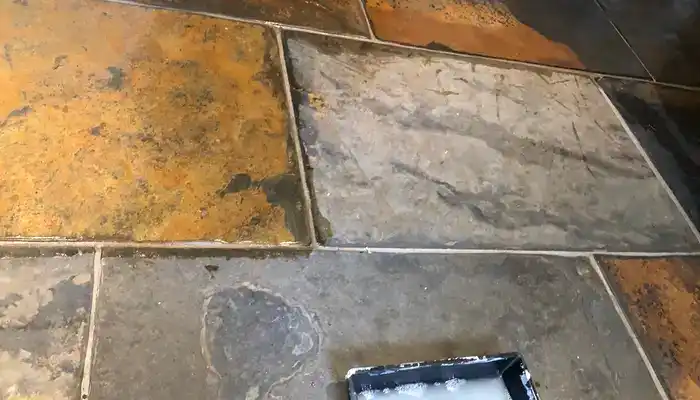
Misdiagnosing finishes can lead to permanent changes in the character of the floor. Riven slate should not be treated as a flat surface unless a different floor character is desired. Impregnating sealers preserve a natural look, while topical sealers are suited for achieving a colour-enhanced or low-sheen finish.
Why Do Some Slate Floors Accumulate Dirt Instead of Cleaning Easily?
If your slate appears dirty shortly after mopping, it’s likely that soil is trapped within the floor’s texture rather than simply resting on the surface. Riven textures, grout joints, old coatings, and high-traffic areas create pockets where organic soil, cloudy water, soap residues, and loose grit can gather. A standard flat mop might merely shift this contamination around instead of fully extracting it from recessed areas.
Traffic lane abrasion leaves light pathways and dulls surfaces where busy walkways experience frequent foot traffic. Homeowners may notice a chalky look, diminished colour, and visual wear as grit leads to microscopic damage on the surface. This phenomenon signifies surface deterioration that alters how the stone interacts with light and retains protective coatings.
Dark grout may indicate contaminated wash water rather than a defect in the joint itself. Dirty water, detergent remnants, mop water, and persistent rinsing issues often accumulate in grout joints and textured surfaces, leaving behind a sticky film or dullness across the tile surface. While professional cleaning discussions elaborate on slurry extraction, wet vacuum control, and residue removal, this hub focuses on understanding why soil reappears.
Why Conventional Cleaning Methods Often Fail to Enhance the Appearance of Slate Floors
If slate looks flat, grey, or lacklustre after mopping, the issue often extends beyond surface dirt. Dullness can arise from degraded sealers, powder formation, surface contamination, traffic wear, residue build-up, or loss of protective layers. Using stronger household cleaners may only introduce detergent residues or disrupt a failing coating without restoring the stone’s original vibrancy.
Sealer failure occurs when the protective layer loses its ability to prevent absorption or maintain a consistent appearance. Homeowners may notice rapid re-soiling, surface peeling, colour inconsistencies, water darkening, and a dull finish that returns soon after cleaning. Professional evaluations can identify whether the failure originates from an acrylic coating, wax system, impregnating protection, or topical treatment before outlining the next steps for the floor.
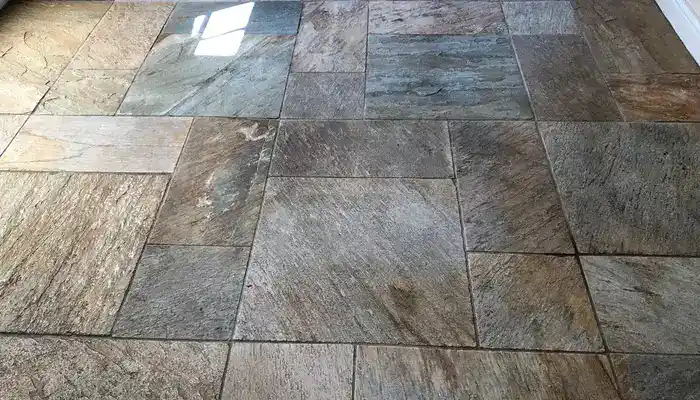
The chemistry of cleaning products impacts slate; extreme pH levels can alter colour or damage protective layers. Safe, pH-balanced maintenance utilises mild surfactants for daily cleaning that leaves no residues, while harsh products may leave residues, strip sealants, or cause irreversible colour changes. Practical maintenance boundaries are explored in Why Slate Floors Can Still Look Tired After Cleaning, where cleaning advice remains focused on the topic.
How Do Old Coatings Affect the Appearance and Assessment of Slate Floors?
Old coatings can make a slate floor appear darker, cloudier, or more uneven than the underlying stone actually is. Coating accumulation often manifests as edge build-up, recessed areas, excessive topical layers, and application residue. Homeowners may notice uneven finishes, darker tile borders, cloudy patches, or sticky spots that complicate the evaluation of the floor.
Acrylic topical sealers create a film on the surface that may start with a satin finish but often show reduced durability in high-traffic areas. Wax treatments yield a classic look, moderate luster, and heritage appeal, yet ongoing maintenance and renewal are critical as the wax ages. Topical urethane sealers provide a highly durable coating with wear resistance, particularly where a wet-look finish or gloss sheen is desired; however, ensuring the substrate is dry is essential.
Tackling build-up falls under corrective measures rather than instructional content. Solvent action, acrylic removal, wax dissolution, chemical penetration, coating stripping, and sealer removal should be discussed on dedicated treatment pages, as these depend on the specific condition of the floor. The broader method route is explored in A Simple Guide To Cleaning And Sealing A Small Slate Floor, while this section clarifies how the history of old coatings can obscure the true slate surface.
How to Identify Flaking, Fading, and Traffic Wear on Slate Floors
If your slate is flaking, splitting, fading, or exhibiting white deposits, it’s essential to distinguish the symptoms before determining the cause. Flaking surfaces, peeling layers, and lamination loss may indicate layer separation, while light pathways typically point to surface wear. White, chalky dusting often signifies mineral salts transported by moisture movement.
Spalling refers to surface deterioration where moisture stress, heat exposure, steam cleaning, seal failure, or weakened surfaces lead to flaking and peeling layers. Homeowners may observe loose fragments, roughened riven textures, layer separation, or localised surface instability. Professional correction begins by determining whether the cause is moisture, heat damage, coating degradation, or structural failure.
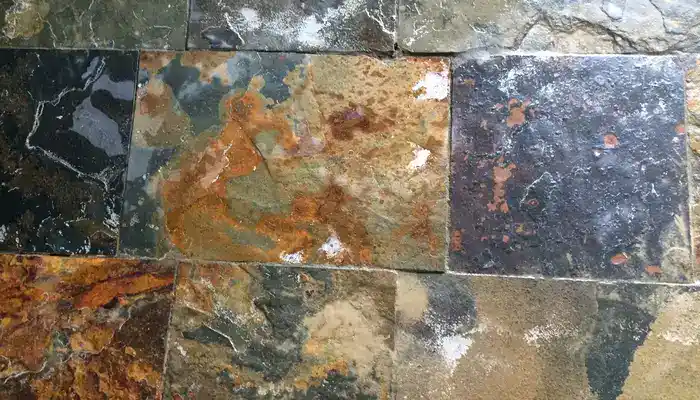
Efflorescence completes the moisture narrative, as mineral salts can migrate through grout and form surface deposits during evaporation. Homeowners may notice haze, chalky white marks, deposits in wet areas, or residues that reappear after cleaning. Professional correction should focus on diagnosing moisture issues and implementing breathable protection strategies instead of sealing the deposits beneath another layer.
Filler collapse occurs in honed-filled tiles when factory fillers fail. Homeowners may observe filler loss, exposure of voids, aesthetic degradation, or small holes where the old filler has deteriorated. The appropriate correction involves local cleaning and refilling before protection, provided there are no structural compromises. Further insights into flaking and repair thresholds can be found in Slate Floor Flaking? What’s Causing It (And How Professionals Repair It).
How to Develop a Tailored Care Routine for Slate Floors Based on Age and Treatment History
Generic care strategies often fall short because a floor’s age, finish, traffic levels, and past treatments dictate what maintenance can realistically achieve. A dense traditional slate hallway, a softer domestic import kitchen, and a wet room floor each require different care expectations. The same mopping routine may keep one floor stable while another becomes patchy, dull, or slow to dry.
Moisture-controlled mopping helps prevent excessive wetting on porous slate and textured surfaces. Using a well-wrung mop, wringer bucket, clean rinse water, and controlled drying reduces cloudy water, detergent traces, and residue build-up. A pH-neutral stone cleaner supports pH balance, routine maintenance, daily cleaning, and a safe formulation that avoids aggressive chemicals.
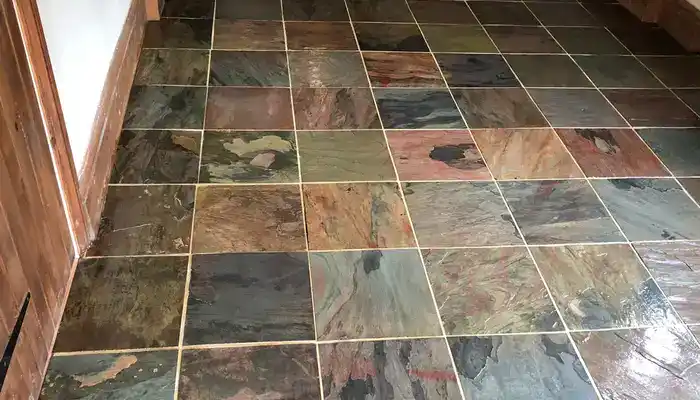
Maintaining sealers is generally a performance issue rather than an automatic product failure. An impregnating sealer provides penetrating protection, seals pores, reduces absorption, offers invisible protection, and maintains a breathable internal barrier while preserving a natural look. A colour-enhancing impregnator activates mineral pigments, deepens colour, enhances visual richness, and offers breathable protection where riven slate can still respond.
Long-term insights are informed by case study evidence, as real floors illustrate how previous treatments impact outcomes. The Slate Floor Cleaning Service Restored This Matlock Floor case study demonstrates how riven texture, old coatings, and maintenance handover shape the final result. This case evidence supports diagnostic accuracy without turning this hub into a treatment manual.
How to Recognise When Slate Floor Issues Indicate Normal Aging Versus the Need for Professional Assessment
Delamination, moisture entrapment, coating build-up, and traffic-related wear necessitate responses that differ from standard dullness observed after a busy week. Typical aging manifests as gradual surface dulling or subtle colour variations, while issues requiring assessment tend to recur quickly, spread, flake, darken, or leave deposits. The critical threshold is behaviour that persists despite reasonable routine maintenance.
Effective diagnostic separation is best achieved by categorising visible signs based on behaviour rather than inferring from colour alone. Loose dirt that returns slowly suggests maintenance issues, while water that soaks into the surface indicates sealing needs. Cloudy edge build-up points to coating history, flaking indicates a need for structural evaluation, and white deposits signal moisture movement. These classifications help homeowners determine appropriate next steps without providing step-by-step guidance.
- Temporary surface soil improves and remains improved following routine maintenance.
- Water darkening or loss of beading signifies worn protection.
- Cloudy film, sticky edges, or darker borders indicate coating accumulation.
- Flaking, splitting, or filler loss necessitates assessment at the repair level.
- White deposits, damp patches, or recurring haze suggest moisture movement.
Professional evaluation becomes increasingly important when multiple signs present simultaneously. Persistent colour fading, high-traffic areas, grout contamination, sealer failure, and layer separation indicate a broader condition rather than a single isolated issue. Distinctions between structural and economic repair thresholds are further examined in Is it Cheaper to Repair or Replace Slate Floor Tiles, where repair and replacement decisions are explored in depth.
How to Choose the Right Steps for Slate Cleaning, Sealing, Restoration, and Learning from Case Studies
The next page should address your specific concern: cleaning limits, colour fading, wet-look results, flaking, repair considerations, or actual floor evidence. This hub emphasises material-level explanations, enabling readers to select the correct path before diving into more detailed pages. This separation helps maintain the focus of the hub without drifting into procedural instruction.
Pages dedicated to cleaning and sealing provide the necessary treatment-specific details. Slurry extraction, managing riven surface contamination, wet vacuum residue removal, and preventing redeposition belong to method pages rather than the hub. The practical route is outlined in A Simple Guide To Cleaning And Sealing A Small Slate Floor, while colour enhancement and wet-look expectations are discussed in Achieving the Signature Wet Look on Natural Slate Flooring.
Case study evidence assists in connecting diagnosis with floors of various origins and treatment histories. Indian origin, Welsh origin, and Brazilian Black Slate can demonstrate differences in porosity, sealing behaviour, moisture exposure, and contamination patterns. Examples such as Indian Slate Cleaning Barnes, Slate Cleaning Corris Gwynedd, and Brazilian Slate Cleaning Abergavenny illustrate how origin, finish, and past treatments influence professional approaches.

David Allen — Abbey Floor Care
David Allen has specialised in slate and natural stone floors across the UK for over 30 years with Abbey Floor Care. His extensive practical expertise in material behaviour, restoration processes, and long-term floor maintenance informs the diagnostic guidance published under the Abbey Floor Care name.
The article Slate Floor Problems Start Below The Surface was first published on https://www.abbeyfloorcare.co.uk
The Article Slate Floor Problems: Issues Beneath the Surface Explained appeared first on https://fabritec.org
The Article Slate Floor Problems: Uncovering Hidden Issues Explained Was Found On https://limitsofstrategy.com
References:
https://homerenonews.com.au/slate-floor-problems-discovering-hidden-issues-explained/